If you’ve ever tried to describe your Maine Coon’s color to someone and given up halfway through, you’re not alone. Maine Coon colors are genuinely complex we’re talking over 75 recognized combinations of base colors, patterns, and markings. A single litter can produce kittens that look like they came from completely different breeds.
This guide breaks down every major color and pattern, explains what makes certain shades rare, and covers the basic genetics behind why Maine Coons look the way they do.
⚡ Quick Answer Maine Coons come in more than 75 recognized color and pattern combinations. The most common is brown classic tabby. The rarest include solid white, true chocolate, and lilac. Color is determined by genetics specifically which pigment genes each parent contributes. Most cat registries accept nearly all natural colors except pointed patterns (like Siamese-style coloring).
Table of Contents
1. How Many Colors Do Maine Coons Actually Come In?
The short answer: a lot. Maine Coons are one of the most color-diverse cat breeds recognized by major registries. That variety isn’t accidental it reflects centuries of natural breeding in the northeastern United States, where no single coat type was selectively favored.
What the Cat Fanciers’ Association Recognizes
The Cat Fanciers’ Association (CFA) officially recognizes Maine Coons in all natural colors and patterns, with very few exceptions. That includes solids, tabbies, smokes, shaded coats, bi-colors, and parti-colors across a wide range of base pigments. The sheer number of accepted combinations is part of what makes Maine Coon coat colors so varied and so confusing to catalog.
What matters to the CFA isn’t just the color itself, but the combination of base color, pattern, and any white markings. A “brown classic tabby with white” is a completely different classification from a “brown mackerel tabby” even if they look similar to an untrained eye.
Colors That Are Disqualified in Shows
One group of colors is consistently excluded: pointed patterns. Coloring like you’d see on a Siamese or Ragdoll pale body with darker ears, face, paws, and tail is not recognized in purebred Maine Coon show standards by the CFA or TICA. A Maine Coon displaying pointed coloring is likely a mixed breed, regardless of how it’s sold.
2. The Most Common Maine Coon Colors
Walk into any Maine Coon breeder’s home and you’ll see certain colors again and again. These aren’t less special they’re just the ones the genetics naturally favor most often.
Brown Tabby – The Classic Look
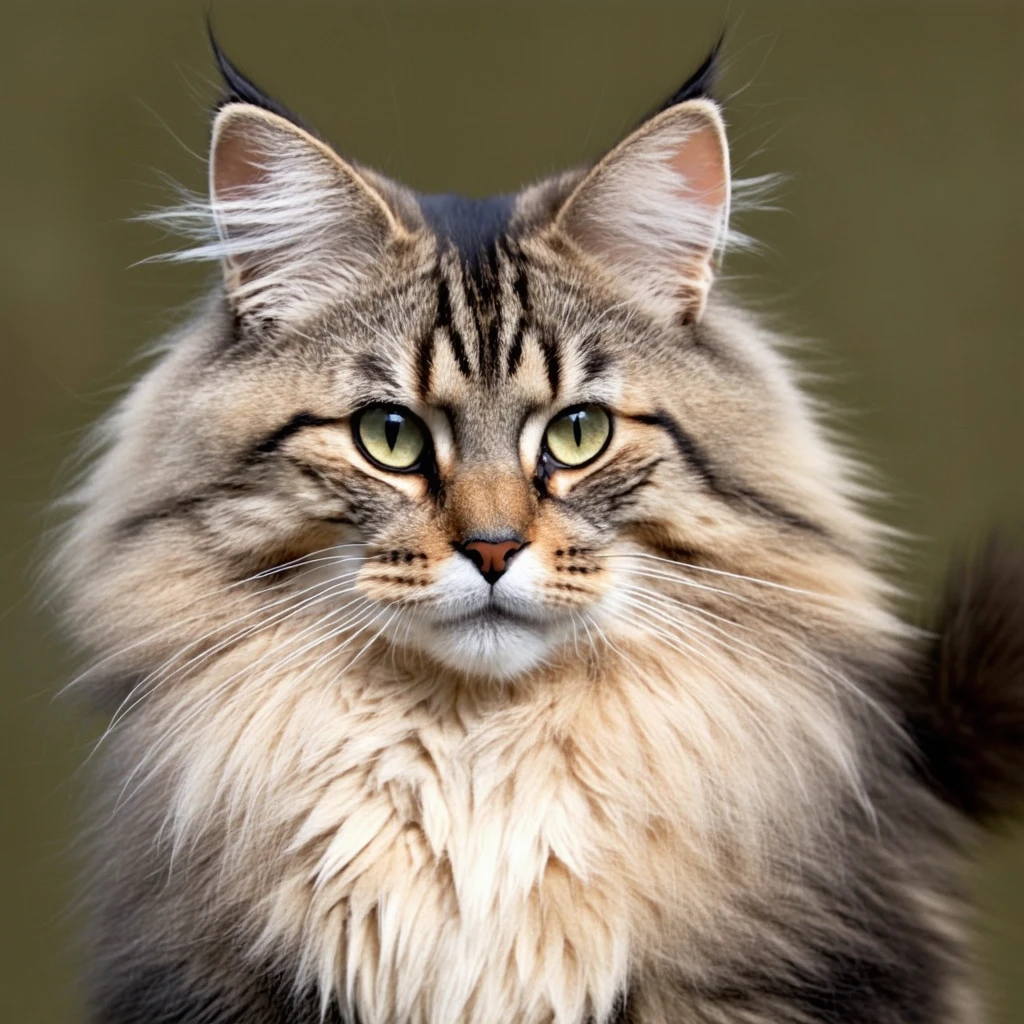
Brown classic tabby is the most iconic Maine Coon color, and for good reason. The rich, warm brown base with bold darker markings is what most people picture when they think of the breed. It’s also the color that photographs best against that signature shaggy mane.
Brown tabbies come in several sub-patterns (more on that below), but the swirling “bullseye” classic tabby is the most widely recognized. If you see a Maine Coon on a magazine cover or in a movie, it’s almost certainly a brown tabby.
Black, White, and Red Maine Coons
After brown tabby, the next most common Maine Coon colors are:
- Black – can be a pure, deep solid or appear in tabby and smoke patterns
- White – less common as a true solid; more often appears as bi-color markings
- Red (orange) – frequently seen in tabby pattern; true solid red is less common
- Blue (grey) – a dilute version of black; popular in both solid and tabby forms
- Cream – a dilute version of red; soft, pale, and often paired with white
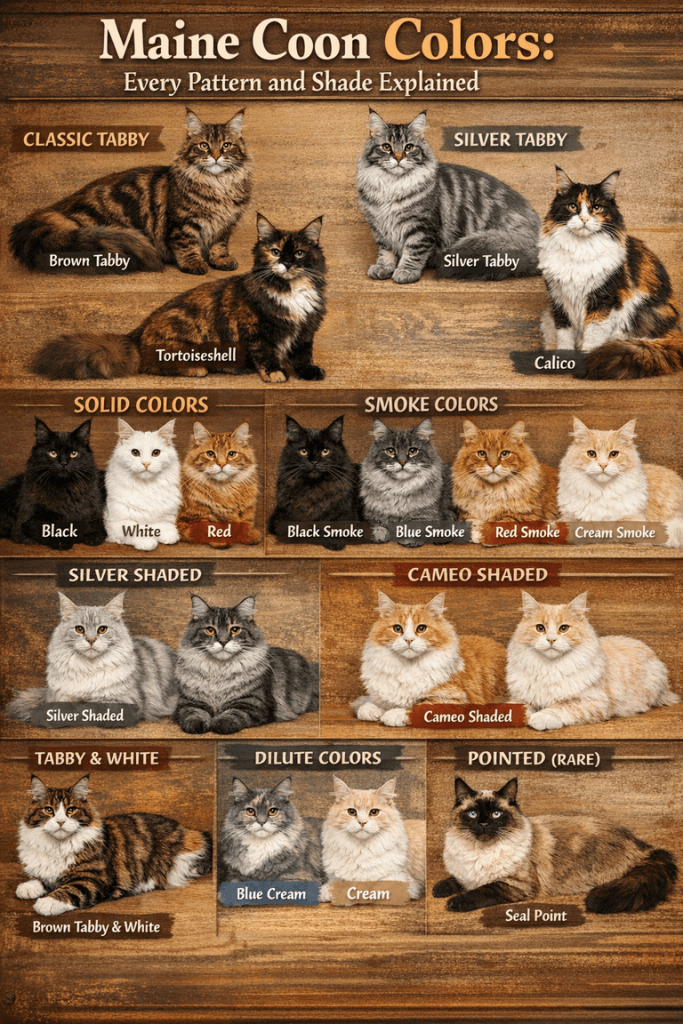
Maine Coon Color Frequency Table
| Color | Pattern Type | How Common |
|---|---|---|
| Brown Classic Tabby | Tabby | Very common |
| Black | Solid / Smoke | Common |
| Blue (Grey) | Solid / Tabby | Common |
| Red (Orange) | Tabby / Solid | Common |
| White | Solid / Bi-color | Less common |
| Cream | Tabby / Solid | Moderate |
| Silver Tabby | Tabby | Moderate |
| Smoke | Smoke | Less common |
| Gold / Chinchilla | Shaded | Rare |
| Chocolate / Lilac | Solid | Very rare |
3. Maine Coon Color Patterns Explained
Color and pattern are two separate things in cat genetics. Your Maine Coon’s color pattern describes how that base color is distributed across the coat and Maine Coons carry some of the most varied pattern possibilities of any domestic breed.
Tabby Patterns – Four Distinct Types
“Tabby” isn’t a single look – it’s a family of patterns. All four can appear in Maine Coons:
- Classic tabby – Bold swirls and a bullseye pattern on the sides. The most common in the breed.
- Mackerel tabby – Narrow vertical stripes running down the sides, like a fish skeleton.
- Ticked tabby – No obvious body markings; each hair has alternating bands of color. Gives an almost sand-like texture.
- Spotted tabby – Broken mackerel stripes that form distinct spots. Less common in Maine Coons than in other breeds.
All tabbies share one universal feature: the “M” marking on the forehead. If you see it, you’re looking at a tabby pattern regardless of what the rest of the coat is doing.
Solid vs. Bi-Color vs. Parti-Color
These terms describe how much white if any appears in the coat:
- Solid – One uniform color throughout with no white patches
- Bi-color – Base color plus white, with white covering roughly one-third to one-half of the body
- Parti-color (Tortoiseshell / Calico) – Two or more colors in a patchy, irregular distribution; almost always female due to genetics
Smoke and Shaded – The Ones People Mix Up
Smoke Maine Coons are one of the most striking Maine Coon color patterns and one of the most misunderstood. At first glance, a black smoke looks like a solid black cat. Part the fur and you’ll find a pale silver undercoat beneath a dark outer layer. The contrast is dramatic.
Shaded coats are similar but lighter the dark tipping only affects the outer portion of each hair, giving the cat a glowing, almost metallic appearance. A chinchilla coat takes this further, with just the very tips of each hair tipped in color.
If you’re curious how a Maine Coon’s size compares across these coat types, our breakdown of Maine Coon size by age and gender covers everything from kitten measurements to full adult dimensions.
4. Rare Maine Coon Colors Worth Knowing About
Some Maine Coon colors appear so infrequently that many owners never see them in person. These are the ones that catch everyone’s attention at cat shows.
Solid White Maine Coons
True solid white Maine Coons white all the way to the root, with no faint tabby ghost markings are genuinely rare. White isn’t technically a pigment color in cats; it’s caused by a gene that masks all other color expression. That masking gene is what makes solid whites uncommon and genetically interesting.
White Maine Coons are also more likely to have odd eyes (one blue, one gold or green) a trait that’s especially prized by breeders and show judges alike.
Gold and Silver Maine Coons
Gold and silver Maine Coons fall under the shaded category but deserve their own mention because of how distinctly they stand out. A shaded silver has a pure white undercoat with black tipping that creates a sparkling, almost frosted look. A shaded golden has warm apricot or gold tones instead.
These are among the most visually striking rare Maine Coon colors and among the most sought-after by serious breeders.
Chocolate, Lilac, and Cinnamon – Do They Exist?
This is one of the most debated topics in Maine Coon breeding communities. Chocolate, lilac, and cinnamon are recognized colors in some cat breeds (like Burmese and British Shorthairs), but they’re caused by specific recessive genes that were historically absent in traditional Maine Coon lines.
The CFA does not currently recognize chocolate, lilac, or cinnamon in Maine Coons for show purposes. Some breeders particularly in Europe are working to introduce these colors through careful outcrossing, but a Maine Coon sold as “chocolate” in most markets is likely mislabeled, or from a non-standard breeding program. Buyer awareness matters here.
5. Maine Coon Color Genetics: Why Your Cat Looks the Way It Does
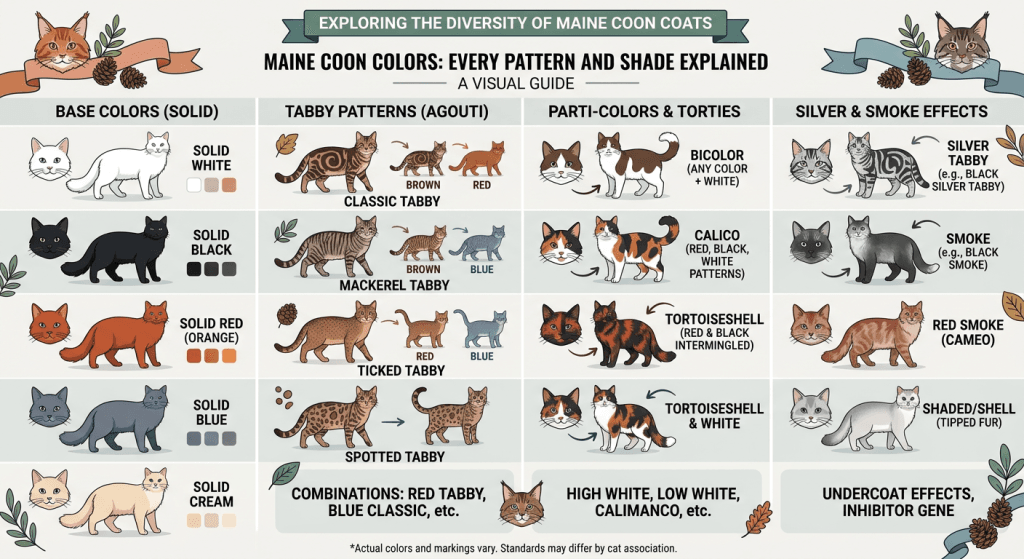
You don’t need a biology degree to understand the basics of Maine Coon color genetics but knowing the fundamentals helps explain why two brown tabby parents can produce a white kitten.
The Base Genes Every Maine Coon Carries
Every cat’s color comes down to two base pigments: eumelanin (black/brown tones) and phaeomelanin (red/orange tones). Modifier genes then dilute, restrict, or pattern those pigments. Key ones to know:
| Gene | What It Does | Example Outcome |
|---|---|---|
| Black (B) gene | Produces dark eumelanin | Black or brown coat |
| Dilute (D) gene | Lightens base color when two copies present | Black → Blue; Red → Cream |
| Orange (O) gene | Switches eumelanin to phaeomelanin | Red or cream coat |
| White masking (W) gene | Masks all color expression | Solid white coat |
| Agouti (A) gene | Controls whether tabby banding shows | Tabby vs. solid |
| Inhibitor (I) gene | Suppresses pigment in undercoat | Smoke or silver coat |
How Breeders Predict Litter Colors
Responsible breeders use these gene combinations sometimes verified through DNA testing to predict what colors a litter will produce. A blue Maine Coon carries two copies of the dilute gene. Breed two blues together and every kitten will be blue or cream. Breed a blue with a black and you’ll get a mix.
DNA color testing for cats has become increasingly accessible, with companies like Basepaws offering panels that identify specific color and pattern genes. It’s not just for breeders it’s a legitimate way to finally know what’s actually going on in your cat’s coat.
6. Does Color Affect Personality or Health?
For most Maine Coon coat colors, the honest answer is no color and personality are not genetically linked in any proven way. A black Maine Coon isn’t more aloof. A red tabby isn’t inherently more energetic. Individual personality in Maine Coons is shaped far more by socialization, lineage, and environment than coat color.
There is one important exception.
The White Cat and Deafness Link
White cats including solid white Maine Coons have a statistically higher risk of congenital deafness, particularly those with blue eyes. According to research published in the Journal of Veterinary Internal Medicine, the W (white masking) gene can disrupt the development of the cochlea, leading to deafness in one or both ears. Blue-eyed white cats and odd-eyed white cats with one blue eye are at the highest risk.
This doesn’t mean every white Maine Coon is deaf many have completely normal hearing. But if you have or are adopting a solid white Maine Coon, a BAER (Brainstem Auditory Evoked Response) hearing test is worth discussing with your vet.
When to See a Vet About Coat Changes
Maine Coon coat colors are set at birth and shouldn’t change dramatically in adulthood. If your cat’s coat is:
- Fading or becoming patchy in areas that weren’t previously pale
- Developing new dark spots on previously solid areas
- Showing texture changes alongside any color shift
…these warrant a vet visit. Coat changes in adult cats can occasionally signal nutritional deficiencies, hormonal shifts, or underlying skin conditions. In most cases there’s a simple explanation but your vet can rule out anything that needs attention.
🐾 When to See a Vet: If your white Maine Coon shows no response to sound, or if your cat’s coat color changes noticeably after adulthood, book a check-up. For white kittens specifically, ask your vet about BAER testing before 6 weeks of age early identification of deafness makes a significant difference in how you raise and train your cat.
FAQ
What is the most common Maine Coon color? Brown classic tabby is the most common Maine Coon color by a wide margin. The warm brown base with bold swirling darker markings is the breed’s signature look. It’s also the color most associated with Maine Coons in popular culture if you picture a Maine Coon, you’re almost certainly picturing a brown tabby.
What is the rarest Maine Coon color? Solid white is arguably the rarest naturally occurring Maine Coon color, followed by shaded gold and true silver chinchilla. Chocolate, lilac, and cinnamon are extremely rare and not recognized by major registries in standard Maine Coon lines. If a breeder is advertising these colors at a premium, ask for documentation of the breeding program.
Can Maine Coons be fully black? Yes solid black is a recognized and legitimate Maine Coon color. A true solid black Maine Coon has uniform dark pigment from root to tip with no tabby ghost markings and no white hairs. In bright sunlight, some black Maine Coons show a faint rusty tinge, which is normal and caused by sunlight breaking down eumelanin pigment.
Do Maine Coon colors change as they grow? Kittens often look different from their adult selves colors typically deepen and patterns sharpen between 3 and 18 months. A kitten that appears silver may develop into a more defined smoke pattern. After roughly 18 months, coat color stabilizes. Dramatic changes in an adult cat’s coat are unusual and worth mentioning to your vet.
Are certain Maine Coon colors more expensive? Yes, in practice. Rare colors like solid white, shaded silver, shaded gold, and odd-eyed white cats often carry higher prices from breeders due to the difficulty of reliably producing them. Expect to pay a premium for these. That said, price alone is never a reliable indicator of a well-bred cat always prioritize health testing and breeder reputation over coat color.
What colors are not allowed in Maine Coon shows? Pointed patterns the Siamese-style pale body with darker extremities are not accepted in CFA or TICA Maine Coon show classes. A Maine Coon displaying point coloring is disqualified from competition under breed standard rules. Some newer or independent registries are more permissive, but the major North American and international bodies remain consistent on this exclusion.
The Real Takeaway
Maine Coon colors cover almost every combination nature can produce from the everyday brown tabby to the head-turning solid white with mismatched eyes. Understanding the difference between color, pattern, and genetics helps you appreciate what you’re actually looking at when you see one of these cats.
Whether your Maine Coon is a common brown tabby or a rare shaded silver, the coat is just the wrapping. For everything else that makes this breed extraordinary including just how big they actually get check out our full guide to Maine Coon size.

Zingi is a digital content creator and pet enthusiast with a passion for helping animal lovers make smarter, more informed decisions. With hands-on experience researching dog breeds, pet care routines, and tech products, Zingi writes guides that cut through the noise and focus on what actually matters for everyday pet owners and tech users.