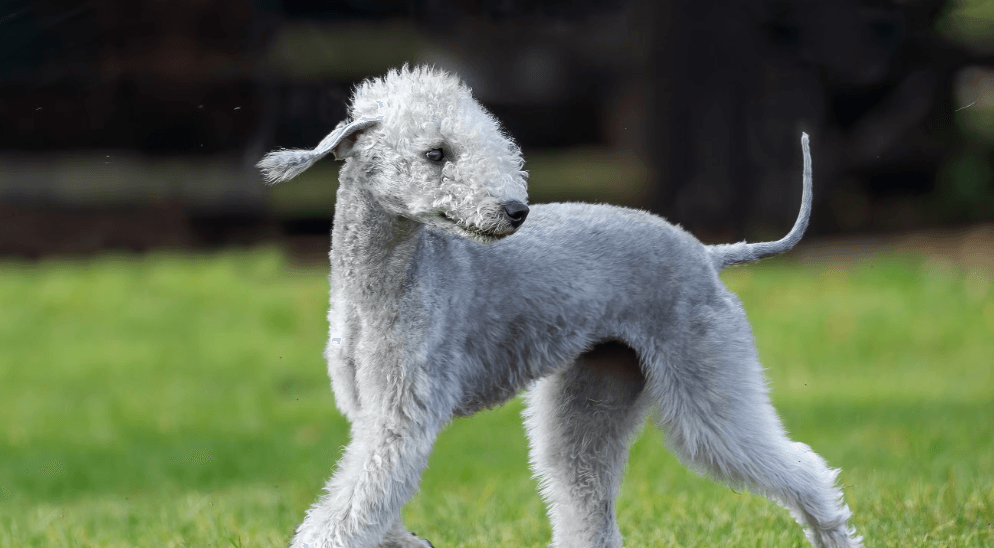
People walk past a Bedlington Terrier on the street, stop, do a double-take, and say some version of the same thing: “Is that a lamb?” The answer is no but you can see why the question comes up. The pear-shaped head, topknot, arched back, and woolly coat create an animal that genuinely looks like it wandered out of a pasture rather than a breeding program. It’s one of the most visually distinctive dogs in the world.
Then you find out what’s underneath the appearance. A dog that could run 35 mph across a field, dive into rivers after otters, work coal mine rat populations down to zero, and hold its own in a fight despite being the size of a house cat. The Bedlington Terrier is, to borrow a phrase, a wolf in sheep’s clothing and understanding that dual nature is the key to understanding whether this breed belongs in your home.
Table of Contents
What Is the Bedlington Terrier? Breed Overview and History
The Bedlington Terrier is a British working terrier breed originating in the parish of Bedlington, Northumberland, in northeast England the same coal-mining region that shaped much of northern England’s industrial identity in the 19th century. The breed’s earliest documented pedigree traces to 1782, making it one of the oldest terrier breeds with unbroken lineage records.
For most of its early history, the Bedlington was known as the Rothbury Terrier, named after a nearby region where the breed was also popular. The name wasn’t officially changed to Bedlington Terrier until 1825, when a dog named Piper the first formally recorded Bedlington was bred. By all accounts, Piper was hunting at eight months old and was still taking badgers and otters in old age.
The breed’s ancestral mix is contested among historians, but the leading theory points to four contributors with very specific purposes:
- Whippet: for speed and the characteristic arched back and rotary gallop
- Otterhound: for endurance and swimming ability
- Poodle: for the distinctive curly, low-shedding coat
- Bull Terrier: for that terrier feistiness and fighting spirit
The result was a dog that could do almost anything asked of it. Coal miners used Bedlingtons to clear rats from the mines. Romany travelers prized them for coursing rabbits and for their discreet, lamb-like appearance useful when the activity involved poaching on estate lands without attracting attention. British elites eventually noticed the breed’s elegance and began keeping them as companions and show dogs. The first dog show featuring a Bedlington class was held in 1870; England’s National Bedlington Terrier Club was established in 1877; the AKC recognized the breed in 1886.
One Westminster moment worth noting: in 1948, a Bedlington named Rock Ridge Night Rocket won Best in Show at the Westminster Kennel Club Dog Show still the breed’s most celebrated competitive achievement.
Quick Breed Stats:
- Height: 15.5–16.5 inches
- Weight: 17–23 lbs
- Lifespan: 11–16 years
- Coat: Thick, curly mix of hard and soft hair blue, liver, or sandy, with or without tan points
- AKC Group: Terrier
- Also Known As: Rothbury Terrier (historical)
- Origin: Northumberland, England
Internal Link Suggestion: British dog breeds ranked by rarity, history, and temperament →
The Great Paradox: Appearance vs. Reality
No breed overview of the Bedlington is complete without addressing the contradiction head-on. This is a dog whose entire public identity rests on looking gentle, calm, and sheeplike and those descriptions are accurate, up to a point.
In the home, with their family, the Bedlington is genuinely mild-mannered. Affectionate, loyal, quiet indoors, and sensitive to their owner’s mood. They enjoy a good run followed by an evening on the sofa. They’re good with children and tolerant with other household pets they’ve been raised with.
Step outside or put them in proximity to a dominant dog, a small animal moving fast, or a situation requiring self-defense and the working terrier comes forward immediately. The Bedlington’s fighting history is not just folklore. These dogs were involved in pit fighting and were specifically prized for their willingness to engage and their refusal to back down once challenged. That instinct doesn’t disappear with generations of companion breeding. It becomes dormant and manageable but it’s there.
The practical implication: a well-socialized Bedlington in the right home is a genuinely excellent family dog. A Bedlington in a multi-dog household with a dominant or pushy dog is a potential incident waiting to happen. The AKC describes them as mild and friendly; Kennel Clubs in New Zealand warn explicitly that they become “terrifying fighters” when challenged. Both descriptions are accurate. Context determines which dog you’re looking at.
Bedlington Terrier Temperament: The Real Picture
Affectionate and bonded. The Bedlington forms deep attachments to its people. They want to be in the room with you, involved in what’s happening, acknowledged. This is not a dog that tolerates being an afterthought or spending most of its time in the yard.
Intelligent, but independently minded. Bedlingtons learn fast they genuinely enjoy mental challenges and pick up commands with less repetition than many breeds. The complication is that terrier independence: they’ll follow commands when they see the point and question the point when they don’t. This isn’t stubbornness for its own sake. It’s a dog that was bred to make decisions in the field without waiting for instructions.
Alert and watchful. Their coal-mine watchdog heritage shows in a dog that notices everything, remembers it, and reacts. They’ll announce visitors, track unusual sounds, and monitor their territory with quiet attention. They’re not excessive barkers, but they do communicate.
Playful and athletic. Don’t be fooled by the graceful silhouette. The Bedlington has a sprint speed that comes from Whippet ancestry up to 35 mph at full gallop and a stamina that reflects its Otterhound lineage. They love to run. An off-leash Bedlington in an open field is a genuinely impressive sight.
Moderate with strangers. Not aggressive toward unfamiliar people, but not immediately effusive either. They tend toward watchful assessment first, then warmth. Early socialization shapes how quickly and comfortably they make that transition.
Suggestion: Terrier breeds ranked by trainability, energy, and suitability for families →
Is the Bedlington Terrier Right for You?
The Bedlington occupies an interesting niche: it’s often described as “the ideal terrier for people who think they don’t like terriers.” That reputation is earned. Compared to more intense terrier breeds, the Bedlington is calmer indoors, more adaptable to apartment living, and notably gentler in daily interaction.
The Bedlington thrives with:
- Active families or individuals who can provide daily exercise
- Owners who enjoy training and want a responsive, thinking dog
- People seeking a low-shedding or allergy-friendlier breed
- Apartment dwellers who commit to sufficient daily exercise
- Homes with children old enough to interact confidently with dogs
- Single-dog households, or multi-dog homes where the other dogs are non-dominant and well-matched
The Bedlington struggles with:
- Homes with cats or small animals (prey drive is real and strong)
- Multi-dog homes where another dog will challenge or push them
- Owners who can’t provide consistent daily exercise and mental engagement
- Families wanting a placid, passive dog with no instincts to manage
- Owners who want off-leash reliability in unfenced areas recall can be unreliable when prey drive activates
One point made by experienced Bedlington owners that rarely appears in general breed guides: the fenced yard is not optional. A Bedlington that spots a rabbit, squirrel, or fast-moving small animal will pursue it without hesitation and at considerable speed. They can be trained, and a solid recall is achievable but not guaranteed in high-drive moments. Fencing is a structural solution to what training alone can’t fully solve.
Training the Bedlington Terrier: Working With the Terrier Mind
The Bedlington is among the more trainable terriers, but “more trainable than most terriers” is a relative benchmark. This is still a breed with independent judgment, a short tolerance for repetition, and occasional selective hearing when something more interesting is happening.
What the research and experienced owners consistently say works:
Positive reinforcement with high-value rewards. Bedlingtons respond well to praise, play, and food. They engage genuinely when training feels like a game. The moment it feels like a drill, engagement drops off.
Short, varied sessions. Ten to fifteen minutes of active training outperforms forty minutes of repetition. Rotate between commands, introduce new challenges regularly, and end sessions before the dog loses interest. Finishing on success matters with this breed.
Early and consistent socialization. This is where Bedlington owners can do the most work with the best return. Puppies exposed to a wide range of dogs, people, environments, and sounds between 8–16 weeks grow into adults that handle novelty with confidence rather than anxiety or aggression. The instinct to fight when challenged doesn’t go away, but socialization shapes how quickly and easily that threshold is reached.
Earthdog and scent work. The Bedlington’s hunting instincts make scent-based activities earthdog trials, tracking, nose work genuinely fun for them. These activities provide mental stimulation that regular walks don’t replicate.
Recall training as a priority. Given the prey drive, a reliable “come” command is worth investing in early and reinforcing consistently. It won’t be 100% bulletproof in extreme situations, but a well-trained Bedlington can be trusted far more than an untrained one.

Bedlington Terrier Grooming: The Investment Nobody Fully Explains
The Bedlington’s coat is one of its most distinctive features and the most labor-intensive aspect of ownership. This is not a low-maintenance breed cosmetically.
What the coat actually is: A crisp, curly mixture of hard and soft hair that grows continuously and doesn’t shed the way most coats do. The Bedlington is considered low-shedding and often cited as a better option for allergy sufferers (though “hypoallergenic” is a marketing simplification no dog is fully hypoallergenic; Bedlingtons produce less airborne dander than heavy-shedding breeds).
The routine reality:
- Brushing: Several times per week to prevent matting, particularly in friction areas (armpits, behind ears, groin)
- Professional grooming: Every 6–8 weeks non-negotiable unless you learn to scissor-clip yourself. The Bedlington’s breed-standard shape (rounded head, topknot, trimmed body, distinctive face outline) requires skill to maintain. A groomer unfamiliar with the breed will produce a dog that looks like a general Spitz mix rather than a Bedlington
- Cost: $50–$90 per professional grooming session, every 6–8 weeks
- Bathing: Every 6–8 weeks, with a gentle shampoo
- Ears: Weekly check; the Bedlington’s low-hanging ears with hair in the canal can trap debris and moisture
One coat fact most articles skip: Bedlington puppies are born dark black or dark brown. The coat lightens dramatically as they mature, typically settling into blue, liver, or sandy tones by 12–18 months. Additionally, if a Bedlington sustains a skin injury that damages the coat follicles, that area grows back darker, sometimes black. It’s temporary but can look alarming if you don’t know to expect it.
Learning to groom at home: Several Bedlington owners do learn scissor-clipping themselves, particularly those who show the breed. Resources exist through the Bedlington Terrier Club of America. The investment in learning is real but pays off over a lifetime of ownership.
Suggestion: Low-shedding dog breeds: which ones actually work for allergy sufferers →
Bedlington Terrier Health: The One Condition Everyone Must Know
The Bedlington is a generally hardy breed with a lifespan of 11–16 years impressive range, reflecting how well some individuals age. That said, there is one health condition so specific to this breed and so serious that it deserves its own prominent discussion.
Copper Toxicosis: The Bedlington’s Defining Health Challenge
Copper toxicosis is an inherited autosomal recessive condition caused primarily by a mutation in the COMMD1 gene, which normally helps the liver excrete copper through bile. In affected dogs, copper accumulates in liver cells, causing oxidative damage, fibrosis, cirrhosis, and if untreated fatal liver failure.
What makes this condition particularly dangerous is that early-stage disease is often silent. Signs typically appear between 2–4 years of age, by which point significant liver damage may have already occurred. Affected females may be more susceptible than males.
Dogs are scored on a three-point scale:
- 1:1 – Normal (both alleles clear)
- 1:2 – Carrier (one affected allele; dog is unaffected but can pass it on)
- 2:2 – Affected (two copies; will develop the condition)
Responsible breeders test all breeding stock and only pair dogs that will not produce 2:2 offspring. Genetic testing is available and should be requested not just mentioned in passing when evaluating any Bedlington breeder. This is the single most important health question to ask.
Management for affected dogs involves a low-copper diet and medications to help facilitate copper excretion. Early intervention, before significant liver damage, substantially improves prognosis.
Other Health Conditions to Know
Patellar Luxation. The kneecap slips out of its normal groove, causing intermittent skipping or hopping. Common in small-to-medium breeds. Mild cases are managed conservatively; severe cases require surgery.
Progressive Retinal Atrophy (PRA). Gradual degeneration of the retina leading to blindness. Genetic testing available; ask breeders for documentation.
Juvenile Cataracts. Eskies and Bedlingtons share a predisposition to early-onset cataracts. Surgical correction is possible in eligible dogs.
Kidney Issues. Renal cortical hypoplasia and bladder stones have been reported in the breed. Monitoring through routine bloodwork and urinalysis catches these early.
Distichiasis. Extra eyelashes growing from abnormal positions on the eyelid margin, which can irritate the eye surface. Relatively common in Bedlingtons; treated surgically in significant cases.
The OFA recommends screening all Bedlington breeding stock for copper toxicosis, patellar luxation, and eye problems prior to any breeding program. These are the minimum questions to ask a breeder and a good breeder will answer them clearly and provide documentation, not vague reassurances.
Bedlington Terrier Price: What Ownership Costs
Puppy price from a reputable breeder: $1,500–$3,000 for a companion-quality puppy with health testing documentation. Show-quality or champion-bloodline dogs from established breeders can run $3,000–$5,500.
Adoption: $200–$500 through breed rescue organizations. The Bedlington Terrier Club of America maintains rescue resources. Adult Bedlingtons do come available, and adopting a dog past the destructive puppy phase has real advantages.
Grooming costs: Plan for $50–$90 every 6–8 weeks, amounting to $350–$780 per year minimum. This is the most distinctive ongoing expense for Bedlington owners compared to shorter-coated breeds.
Veterinary care: Routine annual costs of $300–$600 for a healthy dog. Factor in the potential for copper toxicosis management dietary prescription food, regular liver monitoring via bloodwork, and medication which adds meaningful cost for affected dogs.
Pet insurance: $25–$60 monthly depending on coverage level and the dog’s age. Given the breed’s predisposition to copper toxicosis and the cost of treating it, insurance deserves serious consideration before assuming the dog is healthy.
Lifetime cost estimate: $20,000–$35,000 across an 11–16 year lifespan, depending heavily on grooming frequency, health outcomes, and geographic cost of veterinary care.
5 Things Bedlington Terrier Articles Consistently Understate
1. The coat requires a specialized groomer not just any groomer. The Bedlington’s breed-specific clip (topknot, rounded head, body shape) is a skill set that general groomers often don’t have. Finding a groomer familiar with the breed is worth the extra research. A badly clipped Bedlington looks genuinely wrong the whole distinctive silhouette is lost.
2. Copper toxicosis isn’t just a “thing to be aware of” it’s a breed-defining health consideration. Most breed guides mention it in one line alongside other health conditions. The reality is that it requires active verification when buying a puppy, dietary management in at-risk dogs, and routine liver monitoring throughout the dog’s life. It’s not a footnote; it’s a foundational fact of responsible Bedlington ownership.
3. The fighting instinct is real, managed, and never fully eliminated. Articles routinely describe the Bedlington as “gentle” and “mild.” Both are accurate in most contexts. What they omit is the explicit warning from multiple kennel clubs that these dogs will fight intensely when challenged and are not reliably safe with dominant dogs. This isn’t a reason not to own one it’s a reason to manage introductions with other dogs thoughtfully, forever.
4. They are genuinely fast. The Whippet heritage is not cosmetic. A Bedlington at full sprint uses the same rotary gallop gait as sighthounds and can reach speeds that make recall unreliable when prey drive is active. Owners who treat them as a slow, decorative dog end up with an escape artist.
5. They’re rarer than their reputation suggests. The Bedlington is not a commonly bred or easily sourced dog. Waiting lists with reputable breeders exist. Expect the search for a health-tested puppy from an ethical source to take months, not weeks and treat any breeder with immediate availability and no health testing documentation with appropriate skepticism.
FAQs: Bedlington Terrier
Is the Bedlington Terrier hypoallergenic? The Bedlington sheds minimally and produces less airborne dander than most breeds, making it one of the better options for mild allergy sufferers. No dog is truly hypoallergenic all dogs produce saliva, dander, and urine proteins that can trigger reactions. For most people with dog allergies, the Bedlington is significantly more tolerable than average. Spending time with the specific breed before committing is the only reliable test.
Are Bedlington Terriers good with children? Yes, with appropriate socialization. Bedlingtons are playful, patient, and naturally protective of their families, including children. The caveat is size and energy they’re not a fragile toy breed, and play can get rowdy. Children who know how to interact respectfully with dogs and don’t provoke or overwhelm them tend to develop excellent bonds with Bedlingtons.
Are Bedlington Terriers good apartment dogs? Surprisingly yes, if daily exercise needs are met. The Bedlington is calm and quiet indoors once adequately exercised. They don’t need a yard they need a commitment to daily walks and periodic sprint opportunities in a fenced space. Their low-shedding coat is also a practical advantage in smaller living situations.
How much exercise does a Bedlington Terrier need? At least 45–60 minutes of exercise daily, including some opportunities to run at speed. A tired Bedlington is a well-behaved Bedlington. Without adequate exercise, they become restless, mischievous, and prone to destructive behavior. They’re versatile hiking, fetch, agility, tracking, or simple running in a fenced area all work well.
What colors do Bedlington Terriers come in? Blue (gray), liver (reddish-brown), and sandy all three of which may have tan point markings. Puppies are born much darker than their adult color; blue adults are born nearly black and lighten significantly by 12–18 months.
How often do Bedlington Terriers need grooming? Brushing several times per week, professional grooming every 6–8 weeks. The cost and time commitment are real and should be budgeted before acquiring the breed. The coat grows continuously and requires scissor-clipping by someone familiar with the breed-specific pattern.
What is copper toxicosis in Bedlington Terriers? Copper toxicosis is an inherited genetic condition that causes copper to accumulate in the liver instead of being excreted normally. It can cause liver failure if untreated. The condition is linked to a mutation in the COMMD1 gene. Dogs can be tested and scored: 1:1 (normal), 1:2 (carrier, unaffected), or 2:2 (affected). Reputable breeders screen all breeding stock and should be able to provide test results for both parents of any puppy you’re considering.
Conclusion: The Dog That Rewrites Your Expectations
The Bedlington Terrier doesn’t fit neatly into any category people use to sort dogs. It’s too athletic to be a lapdog, too gentle indoors to be a guardian breed, too independent to be fully biddable, and too lamb-like to look like any of what it actually is. That’s the point. The breed was built on the productive tension between appearance and capability a dog that looked innocuous and delivered the opposite when the situation demanded it.
For the right owner active, willing to invest in grooming, thoughtful about dog-to-dog introductions, and committed to finding a health-tested puppy the Bedlington offers something fairly rare: a dog with genuine personality, genuine history, genuine athleticism, and a look that will stop strangers in their tracks every single walk for the rest of its life.

Zingi is a digital content creator and pet enthusiast with a passion for helping animal lovers make smarter, more informed decisions. With hands-on experience researching dog breeds, pet care routines, and tech products, Zingi writes guides that cut through the noise and focus on what actually matters for everyday pet owners and tech users.