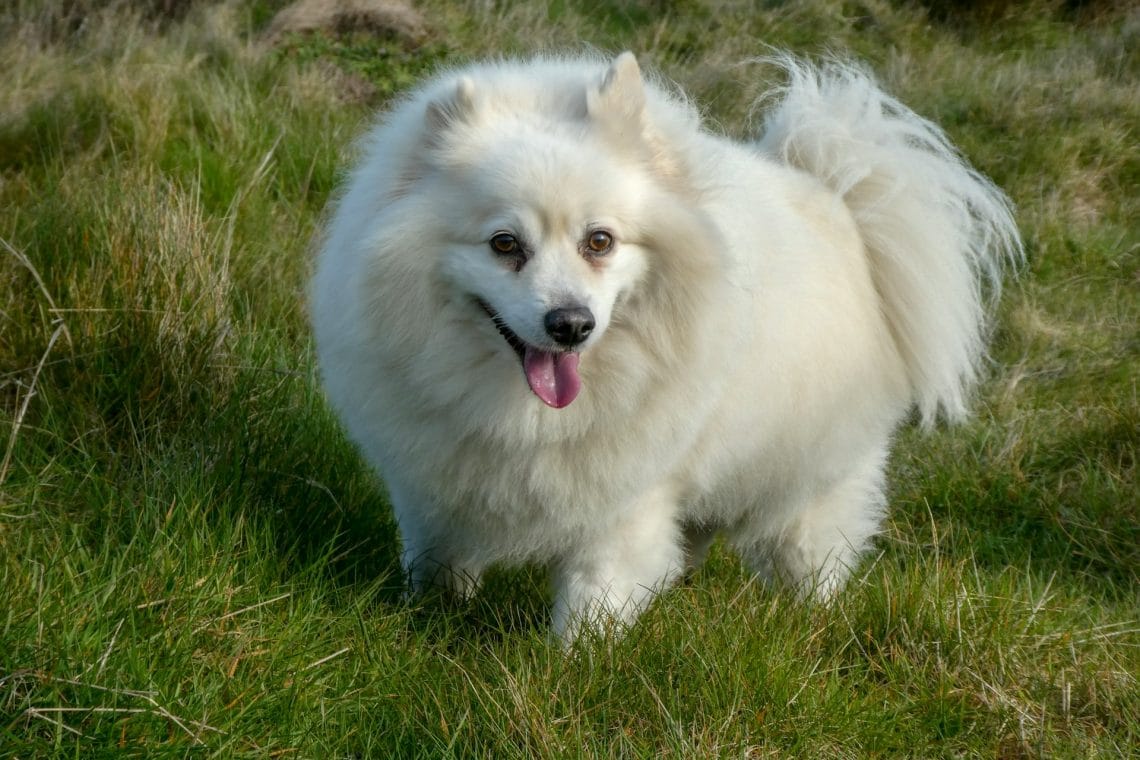
Here’s something that surprises most people the first time they hear it: the American Eskimo Dog is neither American in origin, nor has anything to do with Eskimo culture. It’s a German breed, descended from the German Spitz, renamed during World War I when anything with “German” in the title became deeply unpopular in the United States. The name stuck and so did the breed, which went on to become one of the most beloved companion dogs in the country.
Today the Eskie (as fans call them) is a fluffy, white, sharp-eyed ball of personality that comes in three sizes and fits into a wider range of homes than most people expect. But they’re not a decoration. This is an intelligent, high-energy breed with real opinions about how their day should go and they will let you know when they disagree.
Here’s everything you need to make an informed decision.
Table of Contents
What Is the American Eskimo Dog? Breed Overview and History
The American Eskimo Dog is a Nordic-type Spitz breed with roots in 19th-century Germany. German immigrants particularly those settling in the Midwest states of Minnesota, Ohio, and Wisconsin brought their beloved German Spitz dogs to America, where the breed was further developed as a farm dog, watchdog, and companion.
In 1913, a kennel called “American Eskimo” registered the breed with the United Kennel Club, and the name followed. Then WWI arrived, and the anti-German sentiment sweeping the country made “German Spitz” an uncomfortable label. The breed was formally renamed the American Eskimo Dog, and the two breeds have since diverged enough to be recognized as distinct.
The Eskie’s circus chapter is genuinely remarkable. By the early 20th century, their spectacular white coats, agility, and ability to learn complex tricks made them stars on the traveling circus circuit. A dog named Stout’s Pal Pierre walked a tightrope for the Barnum and Bailey Circus in the 1930s and became one of the first dogs to be advertised through a mail-order puppy catalog which gives you some sense of how popular the breed had become.
The AKC officially recognized the American Eskimo Dog in 1995, placing it in the Non-Sporting Group.
Quick Breed Stats:
- Sizes: Toy (9–12 in, 6–10 lbs) | Miniature (12–15 in, 11–20 lbs) | Standard (15–19 in, 18–35 lbs)
- Lifespan: 13–15 years
- Coat: White or cream double coat; dense undercoat, longer outer coat
- AKC Group: Non-Sporting
- Also Known As: Eskie, American Spitz (historical), German Spitz (pre-renaming)
- Origin: Germany (German Spitz lineage)
One important clarification worth making early: despite the visual similarity, the American Eskimo Dog is not the same as the German Spitz sold by European breeders today. They share ancestry but have been bred separately for over a century, with different breed standards and slightly different temperament profiles.
Suggestion: German Spitz vs. American Eskimo Dog: What’s the actual difference? →
American Eskimo Dog Temperament: What You’re Actually Getting
The Eskie is often described as “alert, intelligent, friendly” all true, but that undersells some important nuances that new owners frequently aren’t prepared for.
They are genuinely smart. This is not the polite “smart” attributed to dogs who follow basic commands. Eskies are observant, problem-solving smart. They learn fast, they remember everything, and they absolutely exploit inconsistency. The same intelligence that makes training rewarding makes a bored or under-stimulated Eskie creative in ways you won’t enjoy.
They are vocal sometimes intensely so. The American Eskimo Dog’s watchdog instinct is strong, and barking is their primary communication tool. They’ll alert you to the mail carrier, a neighbor’s car door, a squirrel three houses down, and an unfamiliar smell through the window. You can teach a “quiet” command, but you cannot train the watchdog instinct out of the dog. This is a real consideration for apartment dwellers or anyone with noise-sensitive neighbors.
They bond deeply and don’t like solitude. Eskies are people dogs. They want to be where you are, involved in what you’re doing. A dog left alone for long stretches regularly will develop separation anxiety and the behavior that comes with it: excessive barking, destructive chewing, and general chaos.
They’re reserved with strangers, not unfriendly. New people typically get a period of watchful assessment from an Eskie before they’re accepted. Early and ongoing socialization shapes how quickly and graciously that transition happens. An unsocialized Eskie can become anxious or overly defensive in unfamiliar situations.
They’re affectionate and playful with their family. Behind the alert exterior is a dog that loves to clown around, learn new things, and be genuinely involved with the humans they love. Many Eskie owners describe them as having a sense of humor a dog that knows it’s being funny.
Suggestion: Best small dog breeds for apartment living: intelligence, noise, and needs compared →
Three Sizes, One Personality: Toy vs. Miniature vs. Standard
One of the Eskie’s genuine advantages as a breed is the size range. The temperament is consistent across all three you’re getting the same personality, just scaled differently.
| Size | Height | Weight | Best For |
|---|---|---|---|
| Toy | 9–12 inches | 6–10 lbs | Apartment living, smaller spaces, less vigorous exercise routines |
| Miniature | 12–15 inches | 11–20 lbs | The sweet spot adaptable to most homes and lifestyles |
| Standard | 15–19 inches | 18–35 lbs | Active families, homes with yards, owners who want a heartier dog |
A few practical notes on the size differences:
The Toy Eskie is the most apartment-friendly, but don’t assume small means low-maintenance. Toy Eskies are still high-energy, still prone to barking, and still need daily exercise and mental engagement. They’re just doing all of that in a smaller package.
The Miniature is probably the most common choice and for good reason it’s genuinely adaptable. Not so small that it feels fragile, not so large that it needs a yard to be happy.
The Standard is often overlooked in the conversation about family dogs. At 20–35 pounds, it’s a proper medium-sized dog with more physical endurance and slightly more settled behavior than the toy and miniature varieties. If you’re comparing the Standard Eskie to other family dogs, it holds up very well.
Is the American Eskimo Dog a Good Fit for You?
The Eskie is more adaptable than its energy level implies. This is not a breed that requires two hours of vigorous exercise it’s a breed that requires engagement. There’s a difference.
The American Eskimo Dog thrives with:
- Families with children old enough to interact respectfully with dogs
- Active singles or couples who want a dog involved in daily life
- Apartment dwellers who commit to daily walks and mental enrichment
- Owners who enjoy training and want a highly responsive dog
- People home for a significant portion of the day
- First-time dog owners willing to invest in training classes
The American Eskimo Dog struggles with:
- Households where the dog will be left alone 8+ hours regularly
- Owners who find barking genuinely intolerable
- Families who want a calm, low-key dog
- Environments where the dog doesn’t have social interaction with people
- Owners who don’t commit to early socialization
One important thing most breed guides won’t say clearly: the American Eskimo Dog is actually a reasonable choice for first-time dog owners more so than many similarly intelligent breeds if that owner is willing to attend training classes and take the dog’s exercise and socialization needs seriously. The breed’s eagerness to please makes it more forgiving of training inexperience than, say, a Chow Chow or Akita. The risk isn’t aggression; it’s that a smart, under-exercised Eskie with no structure becomes a one-dog noise and destruction machine.
Suggestion: Dog breeds that are actually good for first-time owners: an honest assessment →
Training the American Eskimo Dog: What Works and What Doesn’t
The Eskie is among the more trainable dogs you’ll encounter. They pick up new commands quickly, they enjoy learning, and they respond well to positive reinforcement. Training sessions are genuinely enjoyable with this breed when approached correctly.
What works:
Positive reinforcement, full stop. Praise, play, food rewards the Eskie responds to all of them. Harsh corrections or punishment-based methods don’t just fail to work with this breed; they tend to produce anxiety and shutting-down behaviors that make subsequent training harder.
Short, varied sessions. The Eskie’s intelligence is also its trap in training. They bore quickly with repetitive drills. Keep sessions to 10–15 minutes and rotate activities to maintain engagement. The moment it feels like a job to them, you’ve lost the session.
Early socialization. This is non-negotiable. Expose Eskie puppies to a wide range of people, dogs, sounds, and environments during the critical window (roughly 8–16 weeks). A well-socialized Eskie is a confident, adaptable adult. A poorly socialized one becomes the dog that barks at everything and is stressed by any change in routine.
A “quiet” command. You’re not going to stop an Eskie from alerting you. What you can do is teach them that one or two alerts is sufficient and that they should stop on command. Start this training early. It makes a significant difference in daily life quality.
Group training classes. Particularly valuable for socialization purposes. An Eskie learning alongside other dogs in an unpredictable environment is an Eskie getting exactly the kind of exposure it needs.
What doesn’t work:
Allowing small-dog behaviors to slide because the dog is cute. This is where Toy and Miniature Eskie owners most commonly run into trouble. The behaviors that look manageable at 10 pounds become ingrained habits that are hard to break later. Consistent rules from day one matter with this breed regardless of size.
Grooming the American Eskimo Dog: More Than Meets the Eye
That spectacular white coat is part of the Eskie’s identity and it requires consistent attention to stay that way.
The routine:
- Brushing: 2–3 times per week normally; daily during seasonal shedding (spring and fall are heavy blow-coat seasons)
- Bathing: Every 6–8 weeks, or when the coat looks dull or dirty. The Eskie’s coat has some natural dirt-repelling properties, but it doesn’t stay white without maintenance.
- Professional grooming: Every 4–6 weeks for trims, nail care, and deep coat work. Budget $50–$100 per session depending on your area and the dog’s size.
- Teeth: Daily brushing strongly recommended Eskies are prone to early dental disease
- Ears: Weekly check for debris or signs of infection
- Nails: Monthly trimming; active dogs on hard surfaces may need less frequent attention
Shedding: a real conversation. The American Eskimo Dog sheds. Consistently year-round, heavily twice a year. Anyone claiming otherwise is selling you something. White fur on dark furniture and clothing is part of Eskie ownership. A good deshedding brush (slicker or undercoat rake) used regularly makes this manageable rather than overwhelming.
One grooming note that surprises new owners: never shave an Eskie’s double coat. The double coat regulates temperature in both cold and warm weather. Shaving it disrupts this function and can cause the coat to grow back incorrectly a condition called coat funk or Alopecia X, which is already a known risk in the breed. If you’re hot-weather concerned, regular brushing to remove dead undercoat is the correct approach.
American Eskimo Dog Health: What to Know Before You Commit
The good news: the Eskie is a relatively healthy breed with a long lifespan of 13–15 years notably longer than many breeds of similar size. The not-so-good news: there are several heritable conditions worth understanding before you buy.
Hip Dysplasia. More commonly associated with large breeds, hip dysplasia does occur in Eskies. The joint doesn’t form properly, leading to arthritis and mobility issues over time. Responsible breeders test breeding stock; ask for OFA documentation.
Progressive Retinal Atrophy (PRA). A group of degenerative eye diseases that eventually lead to blindness. No treatment exists, but genetic testing can identify carriers. This is one of the most important health screenings to verify in a breeder’s dogs.
Legg-Calvé-Perthes Disease. A degenerative hip condition where blood supply to the femoral head is reduced, causing the bone to deteriorate. Typically presents at 4–6 months of age with limping and muscle atrophy. Surgery usually resolves it with good outcomes.
Patellar Luxation. The kneecap slips out of its normal groove, causing intermittent skipping or lameness. Common in smaller dogs. Mild cases are manageable; severe cases require surgery.
Juvenile Cataracts. Eskies are predisposed to early-onset cataracts, which can progress to blindness. Surgical correction is possible for eligible candidates.
Epilepsy. Eskies have a higher-than-average incidence of epilepsy compared to many breeds. Seizures are managed with medication in most cases.
Alopecia X. Sometimes called “black skin disease,” this condition causes progressive hair loss, often linked to sex hormone imbalances. Spaying or neutering frequently causes the coat to regrow. Non-life-threatening but cosmetically significant in a breed defined by its coat.
Pyruvate Kinase Deficiency. A serious inherited blood disorder causing anemia and low oxygen levels in tissues. Symptoms appear between 4 months and a year of age; the condition is life-limiting. Genetic testing can identify carriers another reason to buy from a health-testing breeder only.
What this means practically: buy from a breeder who health-tests. Not every Eskie will develop these conditions. But the difference between a puppy from a breeder who screens versus one who doesn’t is meaningful over a 13–15 year lifespan.
Suggestion: What to ask an Eskie breeder: a health screening checklist for buyers →
American Eskimo Dog Price: What Ownership Actually Costs
Puppy price from a reputable breeder: $1,000–$2,500, with show-quality or working-line dogs potentially higher. Prices vary by size, region, and breeder reputation.
Adoption: $100–$500 through rescue organizations. The American Eskimo Dog Club of America maintains rescue resources. Adopting an adult Eskie means you skip the high-energy puppy phase not a bad trade.
First-year costs: Budget $2,500–$4,000 covering initial vet care, supplies, training classes, food, and grooming equipment.
Ongoing annual costs: Roughly $1,500–$2,500 per year, covering food ($400–$700), professional grooming ($600–$1,200), routine vet care ($300–$600), and incidentals.
Pet insurance: $20–$100/month depending on coverage level and the dog’s age. Given the breed’s predisposition to several heritable conditions, insurance is worth serious consideration particularly for progressive conditions that require long-term management.
Lifetime cost estimate: $18,000–$30,000 across a 13–15 year lifespan, depending on health outcomes.
5 Things Most Eskie Articles Won’t Tell You
1. The barking is a dealbreaker for some households and articles consistently understate it. Most guides say Eskies “can be vocal” or “make good watchdogs.” What they mean is: this dog will bark at meaningful volume, regularly, in response to stimuli you wouldn’t consider worth barking at. If you live in close proximity to neighbors, have a noise-sensitive household, or are easily frustrated by barking, be very honest with yourself before getting an Eskie.
2. Their intelligence can work against you without structure. Eskies figure out how to manipulate their owners with remarkable efficiency. Cute expressions, apparent innocence, and strategic timing of affection are all tools they use. Without consistent rules from day one, you’ll find yourself with a dog that has very effectively trained you rather than the other way around.
3. The white coat shows everything. Dirt, grass stains, eye discharge all of it lands on a white canvas. Owners who want a consistently pristine-looking Eskie invest in regular grooming. Owners who don’t are fine with a slightly rusty-tinted face most of the time. Neither is wrong, but know what you’re choosing.
4. They can live comfortably in apartments with the right commitment. Despite the energy level, an Eskie that gets consistent daily exercise and mental stimulation can be a genuinely good apartment dog. The caveat is real: the barking needs to be managed, and “consistent daily exercise” means actual exercise, not a five-minute backyard visit.
5. They live a long time. 13–15 years is on the higher end for any dog, and considerably above average for the size class. That’s a meaningful commitment a decade and a half of feeding, grooming, veterinary care, and daily attention. It’s worth thinking about where you’ll be in your life 15 years from now.
FAQs: American Eskimo Dog
Is the American Eskimo Dog related to Huskies or Samoyeds? Visually similar, but not closely related. The Eskie is a Spitz-type breed descended from the German Spitz. Huskies and Samoyeds are also Spitz-type dogs, so they share the general type double coat, curled tail, erect ears but their breeding histories diverged thousands of years ago. The visual resemblance is convergent evolution within the Spitz group, not direct ancestry.
Do American Eskimo Dogs bark a lot? Yes. Barking is inherent to the breed’s watchdog nature and won’t be eliminated with training. You can teach a “quiet” command and manage the behavior, but an Eskie that never alerts to anything is not a well-trained Eskie it’s an anxious one. Factor the barking in before you commit.
Are American Eskimo Dogs good with kids? Generally yes. Eskies are naturally playful and protective with children they grow up with. They tend to be patient and attentive around kids, occasionally displaying herding-adjacent behaviors (following, nudging). As with any dog, early socialization and supervised introductions matter. They’re considered one of the better Spitz-type breeds for family life.
How much does an American Eskimo Dog shed? More than you’d expect. Consistent shedding year-round, with two heavy blow-coat periods annually in spring and fall. Daily brushing during shedding seasons is genuinely necessary. White fur on everything is part of the Eskie experience.
What’s the difference between a Toy, Miniature, and Standard American Eskimo Dog? Size only the temperament, energy level, and care needs are consistent across all three. Toys are 9–12 inches and 6–10 lbs. Miniatures are 12–15 inches and 11–20 lbs. Standards are 15–19 inches and 18–35 lbs. Choose based on your living space and lifestyle; all three are equally demanding in terms of exercise, grooming, and mental stimulation.
Are American Eskimo Dogs easy to train? More than most breeds. The Eskie’s eagerness to please and quick learning make them genuinely rewarding to train. The challenge is maintaining their interest they bore with repetition. Varied, positive, session-based training works well. Harsh methods backfire. Puppy classes are strongly recommended, both for training foundation and socialization.
How long do American Eskimo Dogs live? 13–15 years, which is notably long for any dog. This breed tends to age well when maintained at a healthy weight and provided with regular veterinary care. The long lifespan is one of the Eskie’s genuine advantages and a responsibility worth taking seriously at the outset.
Conclusion: The Eskie Is More Than a Pretty Coat
The American Eskimo Dog’s most obvious feature is that coat white, fluffy, striking against any background. But the breed’s appeal runs considerably deeper than aesthetics. This is a sharp, social, adaptable dog with a genuine sense of humor and a willingness to work with its people that few breeds match.
What the Eskie asks in return is straightforward: include them, engage them, exercise them, and give them a consistent environment. They don’t need a farm or a marathon runner. They need someone who shows up daily, takes their intelligence seriously, and doesn’t leave them alone for most of the week.
Get that right, and you’ll have one of the most entertaining, devoted companions you’ve ever owned for a very long time.
Photo by Nick Fewings on Unsplash

Zingi is a digital content creator and pet enthusiast with a passion for helping animal lovers make smarter, more informed decisions. With hands-on experience researching dog breeds, pet care routines, and tech products, Zingi writes guides that cut through the noise and focus on what actually matters for everyday pet owners and tech users.