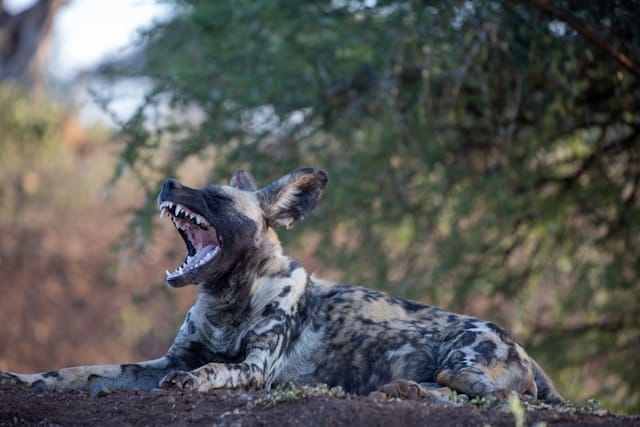
Have you ever caught your domestic dog sitting with just the tip of their tongue sticking out that adorable, motionless pose known as a “blep”? This charming quirk isn’t limited to our couch companions. The African wild dog blep represents a fascinating case of convergent behavior between wild canids and their domesticated cousins, offering unique insights into canine evolution, physiology, and the shared ancestry that connects all dogs.
In this article, we’ll explore how Africa’s most successful predators, the African wild dog (Lycaon pictus)exhibit this same tongue protrusion behavior, what it reveals about canid biology, and why comparing wild and domestic big dog blep moments helps us understand the deeper blep dog meaning across species.
Quick Answer
The African wild dog blep occurs when these endangered predators rest with a small portion of tongue protruding motionless from their lips, identical to the domestic dog behavior. This cross-species similarity stems from shared canid anatomy, relaxed jaw muscles, tongue hydrostatic mechanics, and thermoregulatory adaptations demonstrating that blepping is rooted in ancient canine biology rather than domestication.
Table of Contents
What Is a Blep? Defining the Behavior
Before diving into the wild specifics, let’s clarify the blep dog meaning. A true blep involves:
- Minimal, static protrusion: Just the tongue tip visible beyond the lips
- Absence of motion: Unlike licking or panting, the tongue remains still
- Relaxed context: Typically occurs during rest, not activity
- Brief duration: Usually seconds to minutes, not persistent hanging
This distinguishes blepping from:
- Panting: Rapid, open-mouthed breathing for cooling
- Lolling: Extended tongue hanging during heavy exertion
- Licking: Active, repetitive tongue movement
Understanding this definition is crucial when observing the African wild dog blep in field studies, as researchers must distinguish between normal rest behavior and potential health indicators.
African Wild Dogs: Africa’s Painted Hunters
To appreciate why these wild canids blep, we must understand their unique biology.
Physical Characteristics
African wild dogs (Lycaon pictus)also called painted dogs or Cape hunting dogs possess distinctive features:
Table
| Feature | Description | Relevance to Blepping |
| Large rounded ears | Bat-like, for thermoregulation and sound detection | Indicates sophisticated temperature management systems |
| Lean build | 40-75 pounds, optimized for endurance running | High metabolism affects resting patterns |
| Unique coat patterns | Irregular patches of black, white, tan, and gold | Each individual distinct, aiding observation studies |
| Four toes | Unlike domestic dogs’ five, adapted for speed | Different foot structure but shared oral anatomy |
| Bushy tail | White tip, used for communication during hunts | Social signaling parallels domestic dog behavior |
Behavioral Profile
These highly social predators live in packs of 6-20 individuals with remarkable cooperative behaviors:
- Coordinated hunting: 60-90% success rate (highest among African carnivores)
- Regurgitation feeding: Adults feed pups and injured pack members
- Extensive ranging: Territories covering 400-1,500 square kilometers
- Rest periods: Long recovery periods after hunts, when blepping typically occurs
The Science Behind the African Wild Dog Blep
Field researchers have documented the African wild dog blep during post-hunt recovery periods. The mechanics mirror domestic canids precisely.
Thermoregulatory Mechanics
African wild dogs hunt in packs during cooler dawn and dusk hours but must recover during hot midday periods. Their blepping serves multiple functions:
Heat Dissipation
Unlike cats, dogs possess sweat glands only in their paw pads. The tongue’s vascular surface provides evaporative cooling, but a full hang (lolling) loses too much moisture in arid environments. The minimal blep offers subtle cooling without excessive dehydration.
Muscle Recovery
After 30-60 minute chases reaching 40+ mph, the masseter and temporalis muscles require complete relaxation. The jaw naturally drops, allowing the tongue to slide forward slightly.
The Lingual Hydrostat Principle
Like all canids, African wild dogs possess muscular hydrostat tongueno bones, no rigid structure, just complex muscle fibers that change shape while maintaining volume. When intrinsic muscles relax:
- The tongue elongates slightly
- Gravity pulls the tip forward through the dental gap
- Surface tension and saliva create a “sticky” resting point
- Sensory feedback eventually triggers retraction
This biomechanical process is identical whether observed in a sleeping Greyhound on your sofa or a recovering wild dog on the Serengeti.
Comparing Wild vs. Domestic Big Dog Blep Behavior
The big dog blep phenomenon spans species boundaries, revealing conserved traits.
Similarities Across Canids
| Aspect | African Wild Dog | Domestic Large Breeds (Great Danes, Mastiffs) |
| Trigger | Post-exertion recovery | Post-play or deep relaxation |
| Duration | 2-5 minutes typical | 30 seconds to 3 minutes typical |
| Tongue position | Tip or anterior third protruding | Tip or anterior third protruding |
| Accompanying posture | Lateral recumbency, eyes half-closed | Lateral recumbency, eyes half-closed |
| Pack context | Often surrounded by resting pack members | Often near human family members |
Key Differences
| Factor | Wild Dogs | Domestic Dogs |
| Frequency | Less common due to environmental vigilance | More common due to security |
| Duration | Shorter (predator awareness) | Longer (deeper relaxation possible) |
| Interruption | Usually by environmental stimuli | Usually by human interaction |
| Contextual risk | Vulnerability to lions, hyenas | No predation risk |
The “Security Hypothesis”
Domestic dogs blep more frequently and longer because human-provided security allows deeper parasympathetic nervous system activation. Wild dogs must maintain environmental awareness, shortening their blep duration. This suggests that the blep dog meaning includes a welfare indicator more blepping may signal felt safety.
Evolutionary Origins of Cross-Species Blepping
Why do distantly related canids share this specific behavior? The answer lies in their shared ancestry.
The Canid Family Tree
African wild dogs diverged from the lineage leading to domestic dogs approximately 1.7 million years ago. Both species descended from Eucyon ancestors, wolf-like creatures that populated North America 9 million years ago.
Conserved Anatomy
The tongue’s muscular hydrostatic structure, jaw mechanics, and cranial nerve pathways remained largely unchanged across canid evolution because they serve fundamental functions: feeding, thermoregulation, and communication.
Behavioral Conservation
Resting postures, including the specific muscle relaxation that produces blepping, represent optimal recovery positions refined by millions of years of natural selection. There’s no evolutionary pressure to eliminate bleppingit’s simply a byproduct of efficient rest.
Convergent vs. Conserved Traits
Unlike convergent evolution (where unrelated species develop similar traits independently), the African wild dog blep represents conserved homologyretained from common ancestors. This makes it particularly valuable for comparative studies.
When Tongue Protrusion Signals Trouble
Not all tongue exposure is benign blepping. Researchers and wildlife veterinarians monitor for pathological signs.
Normal vs. Abnormal in Wild Dogs
Table
| Normal Blep | Concerning Sign |
| Brief duration during rest | Persistent hanging tongue |
| Pink, moist tongue tissue | Dry, cracked, or discolored tongue |
| Alert response to stimuli | Lethargy with tongue protrusion |
| Normal pack interaction | Isolation with tongue out |
Health Conditions Affecting Wild Dogs
Canine Distemper Virus: Causes neurological symptoms including jaw paralysis and uncontrolled tongue protrusion. This viral threat has devastated wild dog populations.
Rabies: Hypersalivation and inability to retract the tongue are early signs. Both diseases make tongue position a critical diagnostic indicator for conservation teams.
Trauma: Jaw fractures from kicks by prey animals (zebra, wildebeest) can prevent normal tongue positioning.
For domestic dog owners concerned about their pet’s blepping behavior, our companion article offers detailed guidance: Why Do Dogs Blep?
Conservation Insights from Studying Wild Dog Behavior
Understanding normal behaviors like the african wild dog blep contributes directly to conservation efforts.
Non-Invasive Monitoring
Camera traps and field observations of resting behaviors provide health assessments without disturbing packs. Researchers catalog:
- Blep frequency during rest periods
- Duration and recovery patterns
- Individual variation within packs
Stress Indicators
Reduced blep frequency in tourist-exposed areas suggests chronic stress. Since blepping requires parasympathetic activation (the “rest and digest” system), its absence indicates sympathetic dominance (fight or flight).
Captive Management
Zoos housing African wild dogs use blep observation to evaluate enclosure design. Adequate hiding spots and distance from visitors correlate with more natural rest behaviors, including characteristic blepping.
FAQ: African Wild Dog Blep Questions
Q: Do African wild dogs blep as often as domestic dogs?
No. Wild dogs blep less frequently and for shorter durations due to environmental vigilance requirements. Domestic dogs, feeling secure, enter deeper relaxation states that produce more prominent, longer-lasting bleps.
Q: Can you distinguish individual wild dogs by their blep patterns?
While coat patterns provide primary identification, researchers note individual tongue markings and preferred resting postures. However, blep characteristics aren’t reliable individual identifiers due to behavioral variability.
Q: Does blepping help African wild dogs cool down in the savanna heat?
Partially. While panting provides active cooling, the minimal blep offers passive evaporative cooling without the dehydration risk of full tongue exposurecritical in water-scarce environments.
Q: Why don’t other African predators like lions or hyenas blep?
Different facial anatomy. Lions have shorter, more muscular tongues and different jaw structures. Hyenas possess bone-crushing jaws with limited anterior tongue mobility. Blepping is specifically canid.
Q: Has climate change affected wild dog blep behavior?
Indirectly. Increasing temperatures extend resting periods and may increase blep frequency as dogs seek subtle cooling methods. However, reduced prey availability stresses populations, potentially suppressing relaxed behaviors.
Q: Should I be concerned if my domestic dog never bleps?
Not necessarily. Blepping depends on anatomy, sleep position, and individual relaxation depth. Some dogs are simply “tighter” sleepers. Absence of blepping alone indicates no health issue.
Conclusion
The African wild dog blep serves as a remarkable window into canid evolution, demonstrating how ancient anatomical structures produce identical behaviors across species separated by millions of years and radically different environments. Whether observed in a painted hunter recovering from a successful gazelle chase or your family Labrador napping after a walk, this simple tongue protrusion connects all dogs to their shared heritage.
Understanding this cross-species behavior enriches our appreciation for both wild conservation and domestic dog care. The next time you spot a big dog blep whether in a documentary about African wildlife or on your own living room floor, recognize it as evidence of the deep biological bonds that unite the entire canid family.
By protecting the African wild dog and its habitat, we preserve not just an endangered species but a living link to the evolutionary history that produced our most loyal companions. And in studying their rest behaviors, we gain insights that improve welfare for dogs everywhere, wild and domestic alike.
Photo by Matt Burke on Unsplash
Zingi is a digital content creator and pet enthusiast with a passion for helping animal lovers make smarter, more informed decisions. With hands-on experience researching dog breeds, pet care routines, and tech products, Zingi writes guides that cut through the noise and focus on what actually matters for everyday pet owners and tech users.